Reflecting on the legacy of a leader who enjoyed popularity and dignity at home but faced intractable campaign of demonization and subterfuge abroad.Going by the way Hugo Chavez's rule in Venezuela had been covered for decades, I had expected celebratory headlines in mainstream media throughout the world today after his death. The headlines, however, were more somber with the websites of The New York Times, Washington Post, BBC and CNN all carrying short and to-the-point headlines: "Venezuela's Chavez dies at 58", more or less.
The theme of the coverage was also remarkably similar: Chavez was a popular but divisive figure sworn to harming American interests and his abrupt departure has left Venezuela with uncertainty that could lead to instability and turmoil. And 'transition' featured everywhere regarding the expected outcome for Venezuela now. Keeping the issue of what will happen to Venezuela for later, let me first tell why I admired and even revered Chavez.
 |
| Chávez on a visit to Guatemala (Photo courtesy: Agência Brasil, through Wikimedia Commons) |
First, the image of Chavez as the 'Anti-American icon' was more a creation of media in the west more than the result of his deeds as such. His bombastic rhetoric and his prompt and aggressive measures, like the expulsion of diplomats in response to brazen Israeli invasion of Gaza, were characteristically provocative but if hypocrisy and vested interests had not prevented, even European and North American rulers would have responded similarly to Israel's murderous drive (remember what Sarkozy and Obama talked about Netanyahu in a leaked private conversation). If the other rulers in world cannot live up to their moral obligation and willfully back the murderers thereby changing the meaning itself of morality, than it is not Chavez's fault.
With pro-Americanism as the infallible human value to be cherished, the west (the governments and the media, to be precise) lumped Chavez to the arbitrary 'anti-American' category with likes of North Korean, Cuban and Iranian regimes but his similarity to those other regimes ended at opposing American interests while the dissimilarities stretched endlessly. While anti-Americanism is not bad in itself given the conduct of the Americans in different parts of the world, Chavez's difference with the others was that he chose to fight his detractors in the west in their own terms, using the instruments of democracy and challenging the attempts at violently overthrowing him. As a reference, while the pro-Americanism of Saudi variety is inherently bad (e.g. for breeding religious extremism creating fertile grounds for rise of terrorism and promoting sectarian bloodbath everywhere) anti-Americanism of North Korean variety is equally bad (for using the 'threat from American empire' as an excuse to starve people). Again, it was no fault of Chavez that he was lumped with North Korea for refusing to behave the Saudi monarch's way.
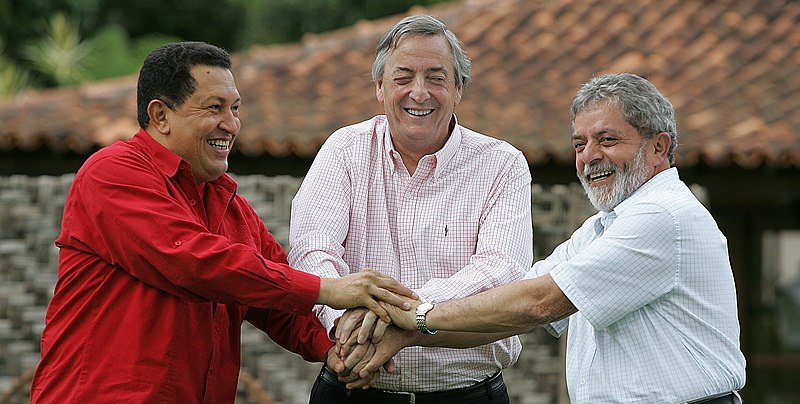 |
| Show of solidarity: Chávez with fellow South American presidents of Argentina and Brazil. (Photo courtesy: Agência Brasil, through Wikimedia Commons) |
Second, he could have followed footsteps of Putin (while geopolitical moves of Putin appear perfectly justifiable in a world where US is the trend-setter, his domestic record as the post-Soviet democratic leader is arguably grim, not least because of his patronage to the Kadyrovites in Chechnya) after consolidating power to develop a 'local' version of democracy. But he never did it. Despite all media claims of Chavez ruling with iron-fist, the reality was always different in Venezuela.


