Himalaya Watch

People, issues. Debates, perspectives. Details, nuances. A crisp view from the top.

Visit the new professional website of Jiwan Kshetry

Showing posts with label South Asia. Show all posts

Thursday, August 20, 2015

An upright officer illuminates the true face of Indian state at the present

Which one is the real Modi? One ranting against the 'invaders' in aftermath of Gujarat riots or the statesman all set to deliver staggering growth and development to India?

Let me start with this. Some time before 'Modi wave' in India changed into a definite wave--with real people passionately wishing to see him as the future prime minister of the country--from a vague perception, I wrote this in December 2013 in Asia Times Online:

Most of his young and educated supporters feel that so long as Modi can deliver good governance and robust growth, issues such as his role in the 2002 Gujarat pogroms remain immaterial, nuisances at worst. 
But given that India is a functioning democracy and with extreme diversity and many faultlines (contrasted to China where an authoritarian government has been able to deliver impressive growth for decades), the trajectory of such a delivery in India is likely to be very different, both from China and a host of other East Asian countries. 
Moreover, what is conveniently forgotten about the 2002 Gujarat violence in discourses today is that, for Modi's brand of politics, 2002 was not a point of time when things went out of hand. This was beginning of an era of a massive social engineering that molded the entire population into a particular shape, dismantling the tolerant and pluralistic fabric of the society. 

If anything goes awry in future and a Modi-led BJP exchanges the apparently harmless developmental agenda with a less wholesome but potentially efficient alternative of another attempt at such social engineering, then that is likely to threaten the pluralist and secular fabric of the Indian state itself.
Ever since, I have half believed and half wished that I would be proved wrong. Whatever Modi's track record before the momentous elections in 2014, he is the only man in the planet to be elected the executive head of 1.3 billion people. 

Wednesday, June 24, 2015

Nepal: A court order highlights the faultines


Identity and state restructuring in Nepal:

A court order and faultlines


Jiwan Kshetry

 A Supreme court order (unsuccessfully?) staying a landmark agreement between Nepal's major political parties has highlighted the simmering divide between those for and against identity-based state restructuring.

"Let's be proud as citizens of a country where politicians pass verdict and judiciary indulges in politics." quipped an angry person in twitter after Nepal's Supreme Court gave an interim verdict objecting to the agreement among major political forces about the central issues in new constitution.

Among others, the major political parties had recently agreed to speed up the constitution drafting process by postponing two crucial and disputed issues: the demarcation and naming of federal units. The agreement says that the task of demarcation will be done later by a Federal Commission and the names will be decided by provincial assemblies.

The court order says that the two crucial issues should be settled now when the Constituent Assembly (CA) is still in existence and cannot be left to be decided later.

Along with the sense of relief that the breakthrough brought after a year-long stalemate in the second CA in the backdrop of failure of the first, voices of discontent have also been building up. Those who favor a strong role for ethnic identity (mainly geographic and caste-based) in state restructuring have felt cheated by the deal which they perceive as the ploy to altogether jettison the role of identity in the process of state restructuring.

As the ruling parties (NC and UML), both vocally opposed to the central role of identity in restructuring the state, along with the UCPN (Maoist)—so far the largest pro-identity political party which seems to have compromised on that stance with the agreement––enjoy a comfortable two-third majority in the CA, the deal had all but ensured the formulation of new constitution in near future.

The pro-identity voices which have been opposing the deal thus risk being increasingly pushed to the fringe. The fact that the political parties advocating or sympathetic to the identity-centered politics, including the Maoists, had lost much ground during second CA vis-à-vis first has not helped the matter.

Monday, March 9, 2015

South Asia's terrible record of Antibiotic abuse comes at a huge price


It is not only the doctors; from the people buying and taking antibiotics on their own and rural health workers using the 'wonder drug' to cure the patients at the earliest, to regulatory bodies doing everything but their job, everybody is to blame for a mess that is likely to threaten the health of, don't gasp, people across the world.


I, along with a number of people with a deeper understanding of the problem of anti-microbial resistance (AMR), doubt even a number of measures outlined here will substantially help the region and the world to prolong the antibiotic era. But if nothing is done, we may be already approaching the threshold to post-antibiotic era, with South Asia regrettably leading the world's march to abyss. 


Less than nine decades from discovery of penicillin—the first antibiotic to be recognized and used as such—there are dire but credible warnings about the onset of a post-antibiotic era. For a health system dependent on the use of antimicrobials in an increasingly critical and diverse ways, the likelihood of extensive resistance of microbes to these magic drugs is the ultimate nightmare.

When the worst fears of people closely watching the resistance patterns of microbes come to be unavoidable realities, a patient with a modest open wound may stare at death and an oncologist will counsel a cancer patient awaiting chemotherapy and organ transplantation like this: there is a very real risk of untreatable infections during the treatment and that is often uniformly fatal, though the scenario was much more different two decades ago or so.

For those still skeptical about the seriousness of the problem, this is how the latest report by WHO titled 'Antimicrobial resistance: Global report on surveillance' opens: "A post-antibiotic era—in which common infections and minor injuries can kill—far from being an apocalyptic fantasy, is instead a very real possibility for the 21st century."

Sunday, August 31, 2014

Imran Khan's momentous gamble: Why Pakistan is wrong to emulate Egypt and not Turkey

Nauman Sadiq

PTI chief Imran Khan and the PAT chief Tahirul Qadri are arguably at the driving seats of Pakistan now; where they'll lead this beleaguered South Asian country is, though, anybody's guess. And the scene of the powerful army being dragged into a confrontation between political powers does not seem pretty from Kathmandu.  

So what is IK, so widely admired and more if not equally loathed, up to, after all? What is the source of his 'unscrupulous pragmatism' that has so badly threatened a democratically elected government? In this insightful piece written before the current 'revolution' started, Sadiq gives a crucial background as to how IK landed the country as well as himself in a difficult situation. 


Imran Khan: A pragmatist par excellence

Rather than the Turkish establishment where Erdogan has clipped the wings of Kemalist generals, it appears that the Pakistani establishment is taking its cue from the Egyptian establishment. Egyptian army has massacred hundreds of Muslim Brotherhood supporters, handed down heavy sentences to hundreds more and imprisoned the entire leadership and thousands of MB supporters, yet the international community did nothing except making some symbolic gestures. This precedent has emboldened the establishment in Pakistan to act with impunity.

Before psycho-analyzing Imran Khan’s colorful personality and determining that where does PTI stands in the Pakistani political spectrum: whether it’s a center-left (liberal) or a center-right (conservative) party, let us first draw a distinction between politics and culture: a democratic system of governance falls in the category of politics while liberalism as a value-system falls in the category of culture.

When we say that Islam and democracy are incompatible, we make a category mistake as big as the Islamists’ misperception that democracy is un-Islamic. They too mix up democracy with liberalism. Here let me concede that there is some friction between liberalism as a culture and Islam as a religion. But democracy isn’t about religion or culture. It is simply a multi-party representative political system that confers legitimacy upon a government which comes to power through an election process which is a contest between more than one political parties, to ensure that it is voluntary. Thus, democracy and politics is about matters of governance and economics while culture is about the socio-moral values and the kind of social matrix that we, as individuals and families, want around us. There is some overlapping between politics and culture but as an heuristic principle this distinction holds true.

When I discuss the political pragmatism of PTI, the reader will further appreciate the fact that realpolitik is mostly about power and rarely about cultural matters. Let us admit at the outset that Imran Khan is an educated, well-informed, articulate and charismatic leader. Being an Oxford graduate he is better informed than our local politicians. And he is a liberal at heart. Most readers won’t agree due to his strong anti-imperialism and the West-bashing demagoguery but I’ll try to explain. Like I said earlier that there is a difference between politics and culture; anti-imperialism is a political stance and liberalism is a cultural temperament. There is a theory called Reflective equilibrium. It states that our minds try to create a harmony between our different sets of beliefs and actions. If there is a divergence between our beliefs and actions, it leads to cognitive dissonance. To avoid this dissonance we try to attune our beliefs and ideology to bring them in conformity with our actions and vice versa.

Now if Imran Khan is a conservative-Islamist, his mind must be a psychological singularity. A playboy-cricketer turned politician who spent most of his youth in the West chasing famous celebrities all over the world, how could he be an Islamist or a conservative? How would his mind create a reflective equilibrium between his beliefs and his adulterous actions? It is just not possible for him to be an Islamist or a conservative. The only ideology that suits his temperament and past actions is the freewheeling liberalism. A clarification here is needed. When I say that he is not an Islamist, I mean that he is not a political Islamist and I am not questioning his personal faith as a Muslim. He seems like a secular Muslim.

Tuesday, May 27, 2014

India: How the secularists caused their own downfall


The triumphant victory of the religious right in India's elections has been possible with a series of follies on part of the incumbent rivals. But the particular fall of two secularist icons, Manmohan Singh and Tarun Tejpal, aptly represents the decadence of the secularist camp. 


Finally, the world’s largest electorate has given a clear verdict. After a decade-long rule of the secularist Indian National Congress (INC)-led coalition marred by incompetence and rampant corruption, the baton has been passed to the opposition coalition led by rightwing Bharatiya Janta Party (BJP) in India paving way for the premiership of its firebrand leader Narendra Modi. This more than makes up for the humiliating defeat of the BJP in 2004 when the Congress-led coalition had upset the incumbent’s applecart by outsmarting their glossy ‘India Shining’ narrative by meticulous work-up at the grassroots level.

With the formal coronation ceremony, Modi will now start the real task of governing the colossus of 1.25 billion people plagued by lingering poverty, increasing inequality and rampant corruption. Much of the media attention will be focused on whether he will be able to replicate much of his reported success in the realm of governance in Gujarat state where he has served for more than a decade as the Chief Minister.

Here, however, let’s explore a slightly different theme: what happens now to the so called secular fabric of Indian state in face of a stable government led by a firebrand Hindutva leader? This, of course, depends upon the future course taken by Modi and his government and many analysts argue that the sheer magnitude of power and responsibility will have the much-needed moderating effect on Modi thereby forcing him to focus on economic prosperity of his people rather than to push for any ideological agenda.

That said, the secularist incumbents in India, set to remain in opposition for at least five years to come and potentially for much longer, have a lot to do now in terms of soul-searching.  

Saturday, April 12, 2014

India polls not a cakewalk for Narendra Modi

 Some facts we tend to ignore on predicting the outcomes of polls in India


The big day is finally here: the biggest democratic exercise in the world has already begun with the first round of voting for the Indian general elections on April 7. 

This is a festival of sort, for the voters because they are going to cast their votes to choose the federal government after five long years of incompetent and corrupt rule; and for the candidates because one can always claim to be the prospective winner till the very moment the results are declared.

The moment of reckoning will soon come for all but single candidate from each constituency, but that is for later.

And without doubt, this is the prime time for the media in India: faring better than the rivals at such times may go a long way towards catapulting the fate of a media outlet and a media house.

A close look at the pre-election coverage in mainstream media in India will make you feel that these polls are all about Narendra Modi and Rahul Gandhi attempting to slice each other's throats with very big daggers; the former being in a very advantageous position to win the fight.

In fact, many sober and intelligent heads have been complaining that a very complicated electoral race with multiple dimensions is being deliberately reduced into an utterly simplified clash between two men in a media frenzy that is fixated at readership and viewership and nothing else.

If elections were to be governed by strictly statistical concept of probability, Modi would obviously slice Gandhi's throat politically. But that is under the condition that the opinion polls conducted so far in India have been representative enough to reflect the sentiments of the voters across the country, something many analysts are not convinced about given the track record of opinion polls in the past.

The intricacies that the opinion polls cannot deal with have to be elaborated from two standpoints.

From the standpoint of the parties and the candidates, these elections mean different things for the incumbent Congress and the opposition BJP; the expectations and the stakes are different for each accordingly.

Tuesday, January 7, 2014

Bangladesh after polls: From the frying pan and into the fire?

The political stalemate in Bangladesh has entered a new phase with the 5 January polls that were boycotted by the opposition and have been labeled as most violent and noticed for one of the lowest voter turn out in the electoral history of Bangladesh. 

In the evening of the poll day, I was asked for a brief assessment of the situation by Victor Martin, a Spanish journalist in Delhi. Some of my statements made way to the report he got published in Spanish newspaper El Mundo. Here is the original exchange from which the readers can have a clearer glimpse of my opinion in the whole affair. 


Is this a real democratic process if the opposition is not going to play in 154 seats?

Theoretically, and what they say ‘constitutionally, yes. But practically no as the things stand today.

This election had low participation. For you, which is the reason? Is the (non) security or is because the people just can vote one party and they don’t want to do it? What do you think?

Both reasons are partially valid. But I think the people are increasingly losing faith towards both the political parties as well as the system itself. The major motive of voters in any election is that the votes they cast will bring about some tangible positive changes in their lives. When they see the whole political practice as a farce played to ensure the personal gains and to feed the ego of the leaders (the PM Hasina and Opposition Leader Zia in this case) there is no genuine motivation for going to caste the votes. Also, unlike the committed voters of the ruling Awami League, a large section of so called ‘swing voters’ were never ready to take the risk of getting injured or even death for merely casting votes in an election of questionable legitimacy. I think this was one of the reasons behind the low voter turn out.

Monday, December 16, 2013

Dimensions of potential Modi-rule in India

(Published by Asia Times Online on Dec 13,  2013 as 'Implications of Modi's rapid rise')

With the incumbent Congress' rout in provincial polls dubbed as 'Semifinals to 2014', the right-wing opposition in India is more effusively focused at propelling Narendra Modi, a controversial figure, to the post of PM. Beyond the fog of whims and rhetoric propagated by the corporate media, there are genuine concerns as to how a militantly communal state leader could lead a country as diverse as India.


Anti-incumbency is often a determining factor in any election and fall of the incumbents in more or less fair elections is thus not unusual. It often so happens that the party or coalition which rides on the tide of anti-incumbency now is overwhelmed by the very tide in the opposite direction the next time around, after second term if not first. As a consequence, it is often noted in history--short term if not long term--when one party or coalition retains power for long enough without overtly authoritarian means.

When the exceptional circumstances and exceptional rulers of states like Srilanka and Afghanistan and nascent democratic exercises in Bhutan and Maldives are exempted, South Asia with nearly a fourth of world population has been reproducing this trend for fairly long period of time in Bangladesh, India, Nepal a asnd Pakistan.

While the elections in Pakistan and Nepal over the past year have seen the spectacular defeat of the incumbents, the Awami League in Bangladesh appears to be in a self-defeating mood after choosing a violent confrontation with the political opposition resulting in chaos rather than an uneventful election through negotiated settlement.

All this is, however, a mere trailer as the big real life drama is about to display itself in India, the world's most populous and South Asia's most powerful democratic state, with the imminent general elections. Most analysts now think it is a lost case for the ruling Congress-led coalition thoroughly battered by financial scams at the end of two terms. This feeling has now been strongly reinforced by the comprehensive rout of the ruling coalition in the assembly polls in four important states.

How much of the Congress' loss across the country will translate into gain for the main opposition Bharatiya Janata Party (BJP), is however, debatable thereby making it rather tricky to predict the outcomes of the 2014 polls; many think a fractured verdict as seen in Delhi assembly polls is as likely as a solid victory for the BJP-led opposition coalition.

India's disconnect with the electoral past

Even as a country that is well accustomed to electoral democracy for more than six decades, the imminent polls in India are not business-as-usual. For the analysts as well as the prospective voters, the differences between the elections of the past two decades and this one are profoundly perceptible.

Indeed, when one focuses on the fate of the incumbent Congress alone, an eerie parallel can be noted between the party's approach to the polls in 1977 after Indira Gandhi's disastrous emergency rule and the same of the scam-ridden Congress leadership now in 2014.

Friday, December 13, 2013

Elaborating the issue of poverty and slavery in India: My interview in The Hampton Institute


Following the publication of 'Explaining poverty and slavery in India: A neglected narrative' in Foreign Policy Journal, I was asked for a brief interview on the issue by Victor Martin from Spanish paper Publico. Eventually I replied to the following set of questions from him through email. He was excited to receive more than he had expected. But later he informed me that the content could not find place in his report because of lack of space. The interview was subsequently carried by The Hampton Institute site titled 'Slavery, Labor Exploitation, and Poverty in India: An Interview with Jiwan Kshetry. Here I reproduce the interview. 


Friday, December 6, 2013

Businessmen to laymen: Why India increasingly loves Modi

A 'Modi'-fication' of Indian politics

Opinion
By Samir Nazareth

(First published by Asia Times Online)

Modi is a personification of what most Indians aspire to - being able to climb out of fetid waters smelling of roses; and having the gumption to mock those in power knowing that they can't reply in kind because of the position they hold. This is the kind of freedom Indians seem to yearn for after being in servitude of monarchies and colonial powers. Modi represents a kind of freedom that is not guaranteed in the Indian constitution but what some Indians fantasize about - power without responsibility and accountability.

Saturday, October 26, 2013

Dissecting 'Islamic' extremism: The Saudi role

How Saudi Petrodollar plays determinant role in spreading, sustaining and multiplying religious fanaticism and extremism around the globe
The author

Opinion

By Nauman Sadiq

It has been tempting to attach the word 'Muslim' to terrorism in much of the western world. It is often forgotten, rather deliberately, that the Al Qaeda and Taliban are but a fringe elements in the Muslim world. The narrative which places the entire Muslim population as a potential if not present day threats to the security of the others has given rise to a dangerous form of Islamophobia in many parts of the world.

So what is the so called Islamic extremism and terrorism? How was it borne and how is it sustained in today's world? What were and are the geopolitical realities-- though downplayed by the mainstream media in the world-- that decide the trajectory of forces like Taliban and Al Qaeda? To be frank, the people all over world have been more misinformed than informed on these issues by the mainstream media. In this highly insightful piece, Nauman Sadiq pointedly explains how the state of Saudi Arabia has been at the center of extremism and fanaticism that goes in the name of Islam. This post, also carried by Asia Times Online earlier this week, is his first in this blog and was taken from the author's blog with his permission.

Wednesday, October 9, 2013

Lowest in life: A case study of three Afghan women

The children playing with the worn out and rusted piece of barbed wire fence and their mothers saying that they are freest in the jail and fear being murdered if let free. Can there be a better metaphor than this for life? I think not.

Out of my inability to produce something authentic this time, I have resorted to reflecting something about life with the help of three beleagured Afghan women whose concept of freedom and liberty is upside down.

Thursday, August 29, 2013

Debating partition of India: culpability and consequences


(A sightly edited version of this article was published by Asia Times Online on August 29, 2013 as "India's partition debate best left to artists")

More than six decades later, the debates around partition of India have become no less intense. While a book on partition and a recent column by a historian put India’s architect Jawaharlal Nehru in spotlight for extreme myopia and culpability, a 2010 novel and a recent Hindi movie go on to explore the terrible cost of partition.


“Hindustan had become free. Pakistan had become independent soon after its inception but man was still slave in both these countries -- slave of prejudice … slave of religious fanaticism … slave of barbarity and inhumanity.” 

These words of Saadat Hasan Manto, the legendary short story writer who arguably depicted the horrors of partition of India most comprehensively, probably capture the essence of the tragedy that followed the much awaited independence of India, and also Pakistan, from Britain. 


One of the massive human tragedies of the past century, the event of partition continues to invite debate to date in the subcontinent and even elsewhere, particularly among the historians, sociologists and psychologists. Was the horror and nasty bloodletting inevitable? If it was not, then who precisely was responsible for the tragedy? These questions have been variously debated even though no infallible conclusion can be reached as such.
"With the tragic legacy of an uncertain future, a young refugee sits on the walls of Purana Qila, transformed into a vast refugee camp in Delhi." Margaret Bourke-White, 1947 (Source: Wikimedia Commons)


As the newly independent states of India and Pakistan pursued their own, albeit diverse, fates after partition, most of the physical wounds of the cataclysmic violence gradually subsided even though a recovery to pre-partition status was an impossibility. This, however, was not the case with the mental trauma forced upon millions of people: those who had not participated in the violence had witnessed it and at the end, there was no answer to the question as to how the people in the subcontinent could live in peace, as evidenced by the lingering tension between the two states that flares frequently enough. 


Who was the culprit?


One line of argument about culpability for partition of India goes like this: the British as the colonial power had so finely sown the seeds of internecine conflict in the subcontinent in their attempt to strengthen their hold of the territories that some kind of mass confrontation between the religious communities was inevitable; that it came in the form of partition-related violence was only a manifestation of an inevitable development. 


While this argument does have merit and partially explains the state of perpetual tension between religious communities in colonized India, it would be well off the mark to conclude that the violence of that scale was inevitable and that it was impossible to avoid it. Also, this argument injudiciously absolves the then leaders of India, to-be-born Pakistan and the then government of Britain of any responsibility towards avoiding the violence. 

For decades after partition, as India under Jawaharlal Nehru fared comparatively better than Pakistan, it was implicitly believed in India that the partition was the result of the intransigence of Muhammad Ali Jinnah and the Muslim League (ML) who were ready to go to any length to realize their dreams, rather vested interests, of a separate Muslim state. By implication, the historic culpability for inciting one of the gravest human tragedies in recent human history thus fell more or less squarely on Jinnah and ML. Leaders of new India, particularly Nehru himself, were thus depicted as having been rather unsuccessful at preventing the bloodletting nevertheless not directly responsible for the same. 
A refugee train on its way to Punjab, Pakistan.
(Source: Wikimedia Commons)


Many scholars and historians, however have had objections to the narrative from the very beginning. Moreover, the issue of culpability, negligence and myopia of the then leadership of India came further into scrutiny after some recent outspoken critiques of Nehru and his brand of politics in India before, through and after partition. In 'Jinnah: India, Partition, Independence' the Indian politician-turned-biographer Jashwant Singh has chronicled how Jinnah was relentlessly pushed to the position by Nehru-led Congress from where it was impossible to demand anything but independent Muslim state. 


In a recent column, historian Zareer Masani has come up with an all out criticism of Nehru, the then British Viceroy for India Mountbatten and the then PM of Britain Attlee for colluding in a terribly myopic arrangement whereby partition was hastily 'forced' into India. While the imaginary scenario of avoiding partition sketched by Masani in the article could be debated for merits, he has substance on arguing that any provisional arrangement for the time being, akin to an unhappy marriage, would have been far better than the hastily executed plan to sever the territory at the terrible price. 


This reference to two statements of Nehru in the article speak a lot about why exactly Nehru cannot be absolved of the responsibility for being instrumental to a situation which led to bloodletting: 


As for Nehru, he first crowed about the mangled Muslim state that emerged from the cutting up of Punjab and Ben­gal, saying, “The truncated Pakistan that remains will hardly be a gift worth having.” But a year later, he said, “Per­haps we acted wrongly.... The conseque­nces of that partition have been so ter­rible that one is inclined to think that anything else would have been preferable.... Ultimately, I have no doubt that India and Pakistan will come close toge­ther...some kind of federal link.... There is no other way to peace. The alte­rnative is...war.” Even as he spoke, the two new states were already at war over Kashmir.


Monday, August 5, 2013

Top five stupid people of the year


This is not new year. Nor is it any other special occasion. But sheer stupidity of some people has prompted me to write this. This write-up is dedicated to all those who are victimized by this sort of stupidity of people whose deeds and attitudes affect if not dictate the lives of thousands if not millions. To be honest, some people in the list deserve more obnoxious adjectives and I am not sure if that amounts to criminality but for uniformity's sake I'll label them simply as 'stupid'. That leaves a lot of scope for reading between the lines. 

Rank 5: Chandan Mitra, India

Politics often thrives in demagoguery. But sometimes the words come back to haunt the speaker. When Amartya Sen, renowned economist, said that he does not want to see Narendra Modi, BJP's likely choice, as the PM of India, this BJP MP came up with the knee-jerk reaction: how dare a person who received the coveted Bharat Ratna from a BJP Prime Minister utter those words? Naturally a furore followed and even the BJP had to distance itself from the remarks even as Sen decently rebuked Mitra like this: if indeed AB Vajpayee asks me to return what he gave me, I am ready to return it.  


Rank 4: Akhilesh Yadav, India 

The Outlook magazine had the cover story "Young MP's: Betrayal of hope" last week where they explored the disappointing under-performance of the young elected people. Yadav is the young Chief Minister of Uttar Pradesh, the most populous state of India with more than 200 million inhabitants. He has been in news of late for allegedly suspending Durga Shakti Nagpal, an administrative officer for clamping down on the mining mafia in the state. The real pretext was, of course, duly fabricated but the truth could not hide for long as one SP leader gloated to have 'transferred Nagpal in 41 minutes' by 'speaking to Mulayam Singh Yadav and Akhilesh Yadav'. Moral of the story: the trust placed by the state electorate on this young man has been misplaced as he has also followed the duly established mode of governance in one of the most backward states in India: patronize the powerful and wealthy, be they crooks or criminals and penalize anyone who dares speak against them. 

On a parallel note, the complicity of Yadav government on helping a Hindu religious zealot to subvert the entire judicial system was exposed by a sting investigation of a weekly. 


Rank 3: Toru Hashimoto, Japan:

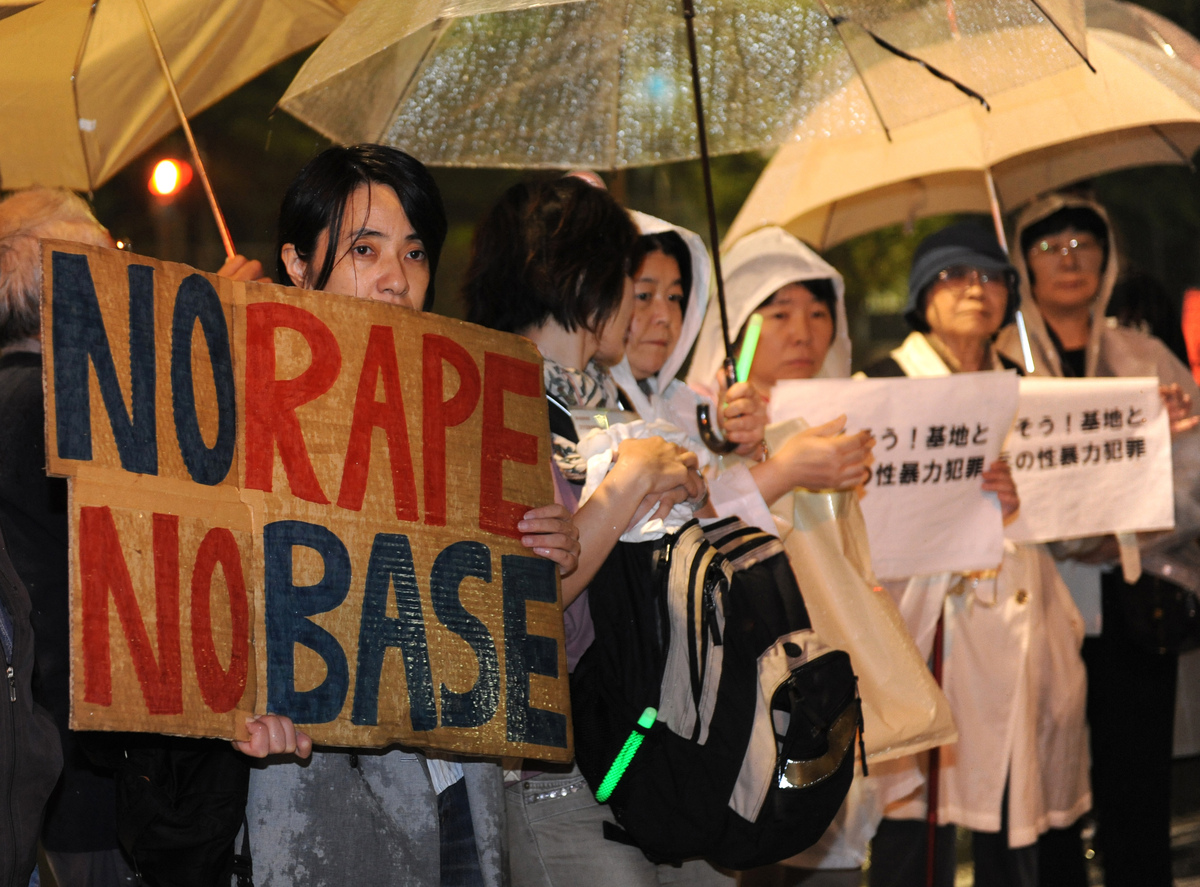
'No rape, No base', says a statement inscribed in a play card held by the people demonstrating against the sexual violence by the American army servicemen in Okinawa, Japan. Indeed making provisions by which the American servicemen can freely indulge in rape and other sexual violence with immunity has been a major sticking point whenever the US tries to finalize the so called 'SOFA' agreements in countries after invasion and devastation have to be followed by military bases. But the outspoken Osaka Mayor Hashimoto meant something else when he passed a damning verdict on the hundreds of thousands of Asian women who were forced into sexual slavery by the Japanese before and during the WWII: that they were not the victims of a crime, rather than the necessary objects to provide 'respite for a groups of high-strung, rough and tumble crowd of men braving their lives under a storm of bullets'. 

While the relentless rightward swing of Japan, with current Prime Mnister Shinzo Abe on the lead, may or may not restore its pre-WWII military glory and/or decades old economic glory, it will definitely alienate its neighbors who have the sour memory from the past. The remarks of the fanatical nationalists like Hashimoto have been, on the other hand, helping Japan to depict itself as the land of utterly self-serving  people devoid of ordinary sense of decency and moral aptitude. If a Chinese group of high-strung, rough and tumble crowd of men braving their lives under a storm of bullets somehow overruns Japan in a conflict and needs a respite, would Hashimoto find it OK to let the Japanese women into sexual slavery to bring them a respite

Tuesday, June 11, 2013

Advani resignation saga: Is BJP squandering the PML-N-like opportunity?

Commentary

Dwelling on the turbulence in BJP after L K Advani resigned from all party posts to protest the party's nomination of Narendra Modi to head the election campaign for 2014 polls. Advani has lately taken back the resignation but that cannot undo every damage that was done. An overview:

I am a rather casual India-watcher and an in-depth analysis is obviously beyond my scope. Nonetheless, the events of the past two or three days in India were nothing less than stunning.

The matter is of course about the turbulence in BJP, the party aspiring to rout the INC-led coalition in the upcoming general elections.

Even though the veteran leader L K Advani has come now full circle after agreeing to resume the pre-turmoil duties, the fiasco has exposed many things about BJP.

To start with, while much of the Indian media had been convincingly dwelling on about the incipient rivalry between Advani and Narendra Modi in BJP, hardly anyone could have guessed the Advani's extreme action of resigning from all three responsibilities in BJP.

After he did, a sense of deja vu had engulfed a large section of media: after all, this was the fitting rebuttal of Advani to party leadership for callously elevating Modi to the post of the party's chief election campaigner.

Of many analytic pieces, this one had particularly caught my attention because it had put many aspects of Advani-Modi rivalry in context.

But now that Advani has acquiesced to the pressure from the RSS and party rank and file and agreed to resume his duty in the party, another flurry of explanations can be expected in the media.

My own inferences from the all developments can be summed up as this:

- While it is widely believed that the charisma of Narendra Modi and his election-winning track record in Gujarat is undeniably linked to his divisiveness, the Advani resignation saga has taken this 'divisive' factor to new height. How further divisive can his legacy be in BJP? Only time will answer.

- Everyone is vulnerable in politics; in longer term if not shorter. It was the same Advani who had literally overruled Vajpayee in the party, 11 years back in Goa in the aftermath of Gujrat pogroms to help Modi navigate through the troubled waters. But now Modi seems to be playing perfectly with the vulnerabilities of a respectable but aging man with waning charisma.

- Finally, the party is the last resort of a politician. He/she may threaten, abuse, criticize and even revolt ,but ultimately it is nearly impossible to escape the dictates of the party. Likes of Uma Bharati and Jaswant Singh in BJP have already experienced it firsthand with a far longer period of distancing from the party but Advani has learned it overnight.

Sunday, June 2, 2013

Secularism in South Asia: The Chickens Come Home to Roost

(First published by Foreign Policy Journal on June 1, 2013)


Over 2008-2009, the tide of secularism sweeping South Asia appeared unassailable. While the chickens have already come home to roost in Pakistan merely after a tenure of PPP-led government, the ailing UPA-II coalition in India led by the Congress fears a similar fate in upcoming polls after two exhausting tenures. Situation in Bangladesh looks more complicated and less predictable but some lessons are hard to miss.


In 2009 elections, the United Progressive Alliance (UPA), the incumbent secular alliance led by the Indian National Congress, got a thumping victory in India. To defeat the rival saffron alliance for two elections in a row, that too with an incremental margin, was no mean achievement and the future of the secularists looked cemented for the first time after the post-emergency debacle of Indira Gandhi in 1977.

It was not long after the lingering turmoil in Bangladesh had followed by a landslide victory of the secular-minded Awami Leage (AL) led by Sheikh Hasina in 2008, nearly decimating the right wing religious parties.
And in a dramatic turnaround, the polls in Pakistan held in 2008 to cap the Musharraf rule had also given the alliance led by PPP, known most widely for its secular credentials apart from corruptibility and tendency to misgovernance, an unambiguous victory.

In the tiny neighborhood of Nepal also, the centuries long Hindu monarchy had been formally uprooted in 2008 with a promise to establish a secular republic, even though the fate of the monarchy had been already sealed by the people’s movement in 2005.

To sum up, the tide of secularism seemed unassailable as the first decade of new century was concluding, sweeping across the political boundaries in South Asia. After a protracted affair with the religion as the driving force in politics, it was believed, people had said ‘enough is enough’ and sought an alternative.
The times have changed now, however, and so have the directions of political wind in various capitals of the South Asian countries.

The coalition of the secular parties in India has been battered so badly by the corruption scams and shoddy dealing of those scams by people at all levels in the government that it has become a heresy to praise the achievements of the UPA-II a year before the completion of its tenure.

With the recent revelation that even the politicians in ruling alliance are mulling over the option of early polls to bring the lackadaisical performance of the once-impeccable Manmohan Singh to an end, the future looks pretty grim for the coalition of secularist forces in India. While all of their loss is unlikely to transform into gain for the rival saffron alliance named NDA, a fractured verdict of the people is bad for both the secularists and the nation in general.

In neighboring Pakistan, Nawaz Sharif’s Pakistan Muslim League-Nawaz (PML-N) has just enjoyed a historic electoral gain. A witty journalist Mohammed Hanif has sarcastically commented that Sharif has won by promising airports to people who do not own even a bicycle, still both the gain for the religion-friendly parties and the loss for the secularists in Pakistan were highly significant. While duly sharing a record of corruption and misgovernance with the PPP, PML-N stands in contrast with the former in terms of its attitude towards the relationship between the state and the religion.

Looking deeper into the results of the polls in Pakistan, the performance of the ruling coalition over the past five years was far more decisive than any other factors like the Taliban’s selective targeting of secular parties prior to the polls, in determining the outcome. In face of intractable Taliban insurgency and failure of the PPP-led government to tackle the problem head on, the assumption, rather wishful thinking, that the Taliban could be better dealt by political powers ideologically closer to them seemed less absurd then it would appear otherwise.

And the tumult and turbulence in Bangladesh now is a bit complicated and rather unsettling, but the lessons to be learnt could be very significant.

Tuesday, September 4, 2012

India Shining: a story less told

Exploring how increasing inequality and pervasive corruption are likely to force the re-scripting of Indian growth story


(Published by Foreign Policy Journal on August 31 2012)


On July 16, Time magazine published a cover story depicting Indian Prime Minister Manmohan Singh as 'The Underachiever'. That was followed by a frenzied debate in India so as to whether that stark a conclusion was appropriate or even justifiable. First as the Minister of Finance during the pivotal years in early nineties and as the two term prime minister over most of the past decade, Singh has been popularly believed as the man behind the liberalization of Indian economy, even though some others doubt this belief. It has been felt for long in India that Singh's government is fluttering and has failed to live up to the expectation of most, especially after a string of mammoth financial scandals descended upon India since late 2010. His unreserved labeling as the 'underachiever' by a foreign magazine, however, came as a shock to many.

After an exhausting two-year period when the government was haunted by one scam after another, many had assessed that the beleaguered government in New Delhi had hit lowest possible. Amid the stubborn street protests and fasts that purportedly intended to end corruption and consciously portrayed the government in very bad light, with general elections in 2014 approaching fast, the ruling alliance has been understandably dreading the reversal of gains made in last general elections.
Then comes the new scandal with a bang to prove that the government's prestige still has the scope of plunging further: the report of the Comptroller and Auditor General (CAG) on coal block allocation pointed that the government had incurred a loss to public exchequer to the tune of Rs. 1.86 trillion by shunning the process of competitive bidding in favor of more convenient and opaque methods for the purpose. The fact that the PM himself held the related portfolio from 2004 to 2009 is adding insult to injury.

What is now widely termed as 'coalgate scandal' threatens to erase any leftover appeal, popularity and credibility of the Singh-led government in India. Even though the opposition alliance led by BJP may not be able to cash out the newly discovered scandal to the extent it wishes and every repercussion of the clash between the two sides may not be favorable to the opposition, the damage to the ruling alliance is sure to be tremendous. This episode is different from every other scam in the past because none of them had directly implicated PM Singh and opposition parties did also have their own share of scams comparable to those of allies in the government. The opposition's demand of PM's resignation also stems from the fact that the more they can throw this government in disarray, the more the likelihood that their luck will catapult in the upcoming polls.

While the print and electronic media in India are now busy with hysteric coverage of the events surrounding the fiasco that has led to deadlock in the parliament, here we will pursue a slightly different angle of the developments.

Sunday, April 1, 2012

Keeping India's 'army-government duel' in perspective

Jiwan Kshetry, Kathmandu


As every other nation state, India too is preoccupied with its national security issue and trying hard to arm itself in face of persisting challenges. Is that attempt paying off? Few recent developments paint a grim picture of how India's defense is faring. 


Birth of India and Pakistan took place through a violent paradox. People there fought a protracted struggle to see away the British. But even as the British were departing, the communal strife had reached such an extent that a violent partition claiming hundreds of thousands of lives was thought to be an option less evil than the potential full-fledged civil war.

Ever since, both the states have undergone through many spells in history when paradox of one kind or the other has dominated the national life. While the economic misery of majority of the people under the British rule was the major factor behind the widespread resentment against them, little was effectively done to alleviate the suffering of people on either side of border while the political issues always occupied a center stage.

For Pakistan, as the Generals eventually found it convenient to interfere in the day-to-day politics with the excuse of 'inept and corrupt' politicians, a to-and-fro movement between civilian and military rule became the norm. And particularly ruthless version of military rule was applied during the tenure of Zia Ul Haq because the geopolitical factors surrounding the Afghan-Soviet imbroglio fitted neatly into the Zia's paradigm of using religious fundamentalism to legitimize an otherwise illegitimate and brutal military rule.

When the ghosts of the Taliban, so tenderly nurtured by CIA-ISI for anti-Soviet crusade, came to haunt Pakistan after Musharraf chose to side with the Americans post 9/11, an era of another paradox set in Pakistan: a country living with large number of poor and illiterate people with economy never in good shape, yet fighting a war with a power that was hard to define.

Over the past decade, Pakistan is dogged in a kind of conflict that has escalated many times and eventually receded but never subsided. As the elites in politics and the army have ruled the country in rotation, their preoccupation has been either their own precarious situation, an intensifying conflict with the arch rival India or the sweeping rebels either assassinating a political figure or establishing Sharia law in certain areas.

While India is now in a historical position far different from that of Pakistan and the journey of independent India to this point contrasts with that of Pakistan in many fronts, the two South Asian powers share some important historic realities. First, the infamous period of Emergency (1975-1977) was the expression of cumulative failure of the electoral politics to solve the outstanding problems of the time; a phenomenon seen recurrently in Pakistan.

Most importantly, the issue of national security has dominated the public discourse on both sides of the border so much that the anti-Pakistan sentiment in India and vice varsa in Pakistan have recurrently reached boiling point. Not only the three major wars between the two rivals fought mainly over the contentious border issues, but also the larger geo-political alignments of the two states have reflected the persisting rivalry.

Tuesday, March 6, 2012

India Poll Results: Reading between lines


-->


Jiwan Kshetry

So the polls in many states of India have yielded now a result, that was predicted widely and was shown well in the exit polls. Few salient conclusions of the results:

1. The political climate is in favor of regional parties rather than the national parties.
2. People's repulsion to the incumbent government in Delhi that resulted from the exposure of innumerable corruption scams has been clearly shown.
3. With nationwide polls for union government in the horizon, the kind of stability the Congress-led UPA provided to the country seems now unlikely after the polls next year.

There are also some less obvious but more important implications of the results:

1. In corruption-ridden states like Uttar Pradesh crippled by hunger and penury, the option was to choose between evil and less evil. Anti-incumbency factor made the now-winner SP look less evil and it won. This means, UP had no luck like that of Bihar where in the last polls for state, the decades old notoriously corrupt regime of Lalu Prasad Yadav was overthrown by a definitely better option of Nitish Kumar who promised and then delivered too. That phenomenon is now pushed further away in the future with SP, which lost last time just because of incumbency factor, in power.

2. While the decline of the Congress-led secular alliance has benefited the opposition saffron alliance led by BJP in many states, that is more indirect. And the performance of BJP itself, apart from its allies, has been bad even in states like Punjab where the incumbent coalition won; let alone the states of huge significance like UP where BJP even lost two seats won in the previous poll. Saffron coalition is in relatively better position than during the last general elections but that may matter little.

3. Despite the sensational anti-corruption crusade by the so called 'Team Anna', and its visibility in the media and social sites, that mattered little when it came to ballot box. Hard political realities in ground and the infamous exercise of money and muscle power played again the pivotal role and not many politicians won election by being incorruptible, at least in visible scale.

4. Last, but not the least, despite the six and half decades long democratic practice, Indian democracy has ended up recycling the same lot of evil and not evil politicians as in the common metaphor. Potential for any radical change in the political culture is next to nil, at least for now.

Sunday, February 26, 2012

Perennial triumph of corruption in South Asia

As the struggle rages in Middle East and the news from South Asia also focus on political crises and challenges, one thing flourishes as ever: corruption. Despite the ongoing ‘crusade’ against corruption and the sensationalism around the movement, it is here to stay for long; none knows how long. 
Even as the attention of the whole world is drawn to the rapidly evolving events in the Middle East, news from other parts of the world have now been deprived of the attention they deserve ordinarily. Yet they are as important as ever and it is prudent to examine their significance even though the evolving shift of paradigm in Middle East is of utmost importance in understanding the contemporary geopolitics.

In South Asia, multiple crises have emerged over the past few years but some have grown to critical extent over the past few weeks to months. While Pakistan’s endless tussle between shaky civilian institutions and assertive military has now been complicated by the apparent entry of the judiciary as the third player, acuteness of the political crisis in Maldives has been well appreciated over the past few weeks.

When high level of corruption is there, the societies get stuck
like this vehicle has done in the mud. But it is far harder to pull
societies out of rampant corruption than to extract this vehicle
from the mud. (Photo Courtesy: Arjun Acharya)
At the same time, it is a common realization in Nepal that this small landlocked nation is approaching a crisis with potentially devastating consequences as the political parties have now used up all their political capital with no constitution set to be ready after squandering the whole four year-period after the elections for Constituent Assembly (CA) in 2008.

In India, there is no significant threat to the system and its stability and indeed polling is underway in many of the states and even the polls for Union parliament and next government are approaching but this powerhouse of South Asia is now reeling under stress after mammoth corruption scams were exposed recently and relatively slowing pace of growth has been confirmed.

Amid all these things that keep changing with time, there are some attributes that are shared by people across South Asia and even beyond; and those barely change with time. The perennial problems of penury and poverty are routinely overshadowed by the hysteric coverage of terrorism and power tussle in capital in Pakistan, obsession to India’s apparent high growth and giant leap to become next great world power in India and rise and fall of governments in Kathmandu in Nepal.

Here we will look into one of such common attributes shared by all of the South Asian societies: corruption; and how these societies have adapted to the high level of it.

विजय कुमारको खुशी पढेपछि

जीवन, खुशी अहंकार

जीवनमा अफ्ठ्यारा घुम्तीहरुमा हिंडिरहँदा मैले कुनै क्षणमा पलायनलाई एउटा विकल्पको रुपमा कल्पना गरेको थिएँ, त्यसलाई यथार्थमा बदल्ने आँट गरिनँ, त्यो बेग्लै कुरा हो त्यसबेला लाग्थ्योः मेरा समग्र दुखहरुको कारण मेरो वरपरको वातावरण हो, यसबाट साहसपूर्वक बाहिरिएँ भने नयाँ दुख आउलान् तर तत्क्षणका दुरुह दुखहरु गायब भएर जानेछन् कति गलत थिएँ !


Read more from Dashain Issue

Debating partition of India: culpability and consequences


Read the whole story here

Why I write...

I do not know why I often tend to view people rather grimly: they usually are not as benevolent, well-intentioned and capable or strong as they appear to be. This assumption is founded on my own self-assessment, though I don’t have a clue as to whether it is justifiable to generalize an observation made in one individual. This being the fact, my views of writers as ‘capable’ people are not that encouraging: I tend to see them as people who intend to create really great and world-changing writings but most of the times end up producing parochial pieces. Also, given the fact that the society where we grow and learn is full of dishonesty, treachery, deceit and above else, mundanity, it is rather unrealistic to expect an entirely reinvigorating work of writing from every other person who scribbles words in paper.


On life's challenges

Somebody has said: “I was born intelligent but education ruined me”. I was born a mere child, as everyone is, and grew up as an ordinary teenager eventually landing up in youth and then adulthood. The extent to which formal education helped me to learn about the world may be debatable but it definitely did not ruin me. There were, however, things that nearly ruined me. There came moments when I contemplated some difficult choices. And there came and passed periods when I underwent through an apparently everlasting spell of agony. There came bends in life from which it was very tempting to move straight ahead instead of following the zigzag course.


Read more