There is little doubt that the boycott movement is in constant growth and not simply because of the recurring news of artists and academics refusing to visit Israel, or take part in Israeli-sponsored events. Equally significant is the existence of strong layers of support being provided by civil society that makes it possible for artists, academics and others to adhere to the call of boycott, without fearing serious repercussions.
It is an event "of cosmic proportions", said one Palestinian academic, a befitting description regarding Stephen Hawking's decision to boycott an Israeli academic conference slated for next June. It was also a decisive moral call which was communicated on May 8 by Cambridge University, where Hawking is a professor.
Hawking is a world-renowned cosmologist and physicist. His scientific work had the kind of impact that redefined or challenged entire areas of research from the theory of relativity, to quantum mechanics and other fields of study. This towering figure is also wheelchair-bound - suffering from complete physical paralysis caused by amyotrophic lateral sclerosis (ALS) disease. For Hawking, however, such a painful fact seems like a mere side note in the face of his incredible contributions to science, ones that are comparable to only few men and women throughout history.
What is considered a prestigious scientific conference in Israel is hosted by President Shimon Peres, most remembered by Lebanese and Palestinians for ordering the shelling of a United Nations compound near the village of Qana in South Lebanon in 1996.
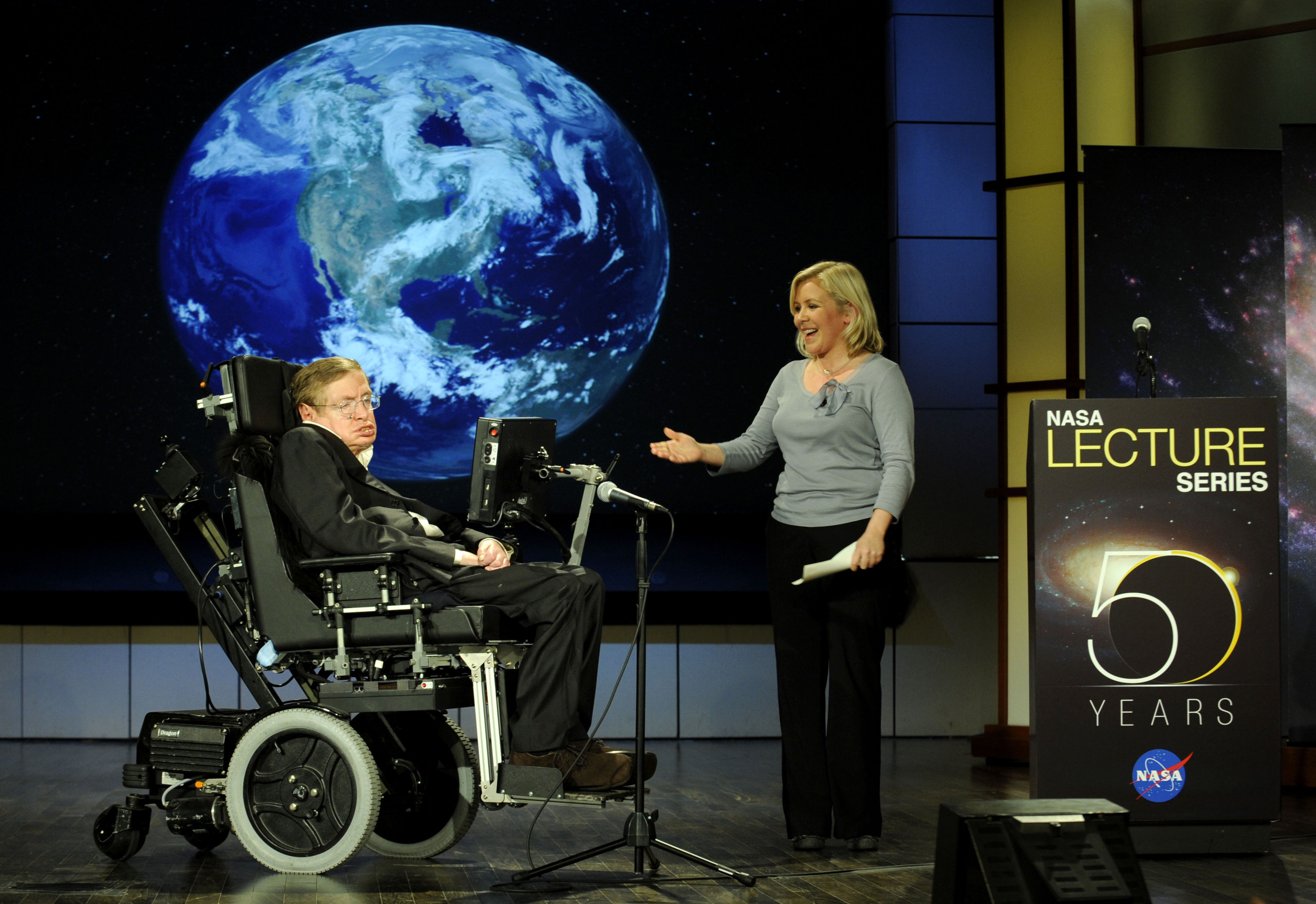 |
| Stephen Hawking being presented by his daughter Lucy Hawking at the lecture he gave for NASA's 50th anniversary Source: Wikimedia Commons |
The compound was a safe heaven, where civilians often sought shelter during Israeli strikes. Not that time around, however. 106 innocent people that were mostly children and women were killed and 116 wounded, including UN forces. That harrowing event alone would have sent Peres, then Israel's prime minister, to serve his remaining years in jail.
But of course, Israel is above the law, or so the Israeli government believes and thus it has consistently behaved accordingly in the last 65 years with a price tag of uncountable lives, untold destruction and protracted suffering of entire nations.
Hawking's response to the boycott call was immensely important. The man's legendary status aside, the Boycott, Divestment and Sanctions (BDS) movement has proved more durable and successful than its detractors - mostly Israel's apologists - want to believe.
Hawking's decision was also a testament that reason and morality should and must go hand in hand. Israel's boasting of its scientific accomplishments should mean zilch if such technology is put to work to advance state violence, tighten military occupation and make killer drones available to other countries, thus exporting violence and mayhem.
 | ||||||
| "Refuse to finance the occupation – Boycott Israel" – a Swedish poster calls for a boycott of Israel Photo by Jacob Rask, via Wikimedia Commons |
The same "science" was used in abundance in Israel's latest two wars on Gaza (2008-09 and 2012) which claimed thousands of lives between the dead and wounded.


